
Accelerating Product Launch Through Smart Planning | MVP
Best practices and successful examples of Minimum Viable Product (MVP) development
Growing big and going global is what many young companies want. Some spend a lot of time, money, and brainpower developing finished products with great functionality. How can you conserve such resources, use them wisely, and still be successful? What experiences has innFactory GmbH had with MVP development through co-innovation of Laura AI, and what is Tesla’s secret recipe?
Best practices
Defining the product
The product should be precisely defined using texts, images, mockups, or even better, a clickable In-Vision prototype to highlight the most important property of the product. Usability test sessions are suitable here to test and evaluate user behavior at an early stage.
Identifying the target group and competitors
Who are you developing the product for? What do these people have in common? Is there a competitor? Who are the early adopters?
What are the exact core functions
What will be the main feature of the product? Which features are unique in the market? Which features will delight users?
Asking questions
What information do you want from customers? What do customers think of the idea? Will they buy it? How much will they pay for it? How often will they use it? Who will they share it with?
Gathering information
How do you gather all the important information from early adopters? – possibly from comments, forms, surveys, Google Analytics, or integrated app tracking components
Prioritize
When developing an MVP for an app, you quickly notice that you’re thinking in a dozen different directions and getting scattered. It often becomes quite chaotic. That’s why it’s important to have clear priorities and essential tasks. You shouldn’t lose sight of the core functionalities of the product.
RoboAdvisor Laura AI as MVP
Laura AI RoboAdvisor for real estate financing
At the beginning of the MVP Laura AI, the question was in which area of a bank digitalization through co-innovation could be implemented. Together with Volksbank Raiffeisenbank Rosenheim-Chiemsee eG, the idea of a robo-advisor for construction financing emerged. Other areas, such as checking account opening, can already be handled 100% mobile at most direct banks. After the joint ideation and the determination of the product owner and scrum master, the first sprint of MVP development began. The goal of the construction financing calculator was to guide the potential construction financing customer step by step through the calculation process and ultimately create and present a financing concept. The development of Laura AI took place in three-week sprints. From the beginning, all project stakeholders were involved. Only in this way did it seem possible for us as innFactory GmbH to bring together the banking and IT worlds. Together with construction financing advisors and innovation managers from VR-Bank, a so-called sprint review took place after each sprint.
Review, to exchange about the current development status of the MVP and to obtain feedback and new technical input from bank advisors. In MVP development, it was especially important to us that people are at the center. Through so-called “advisor sessions” and interviews with financing specialists, we were able to precisely determine the product content of the virtual financing assistant from both a technical and banking perspective. We conducted the usability test session mentioned above together with trainees from VR-Bank. We then used this initial feedback from our “early adopters” to tailor Laura AI even more closely to customer needs. This way, we managed to implement the feedback loop Build measure, learn throughout the entire development period of the Robo-Advisor Laura AI.
Tesla’s Secret Recipe
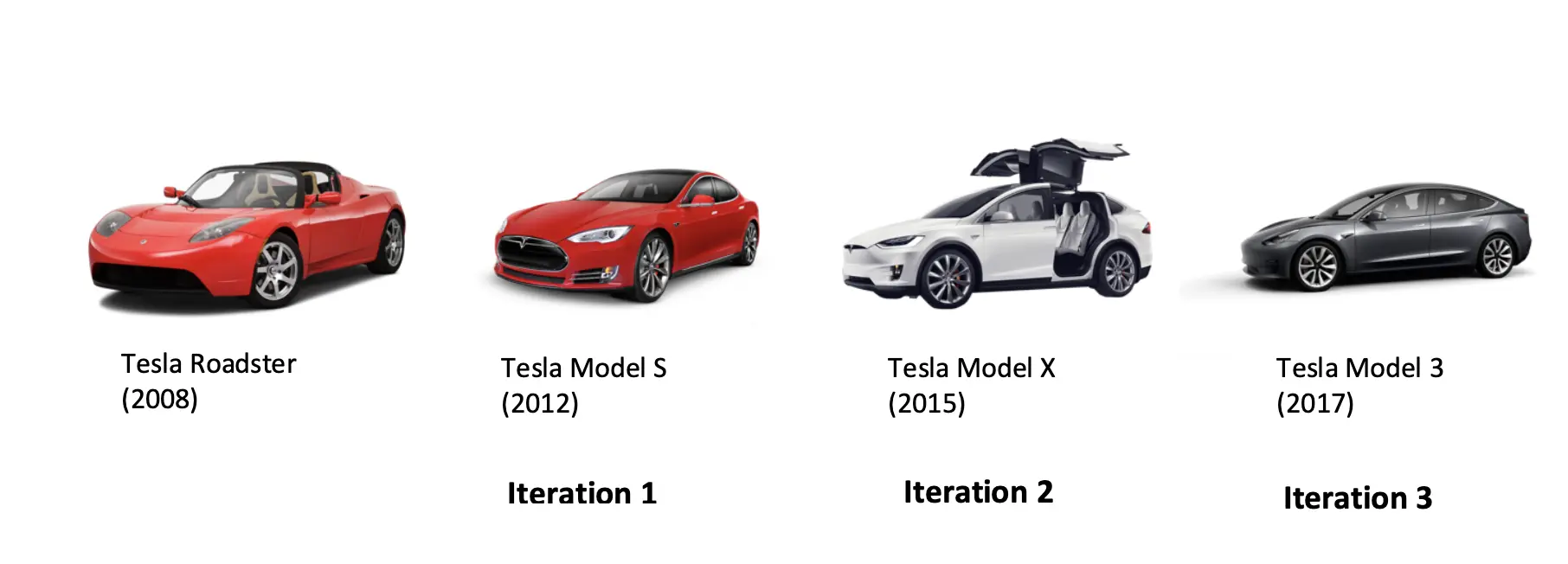
The Tesla Roadster was Tesla’s first production vehicle. This electric car is an example of a very high-quality Minimum Viable Product. Designing an MVP doesn’t necessarily mean building cheap or poor quality. A Lotus Elise was used as the chassis. 6,831 interconnected batteries, also used for laptops, were used as energy storage. Doesn’t sound exactly perfectly engineered, but the Roadster goes about 300km with it. The early adopters were wealthy individuals who didn’t depend on the Roadster as a daily means of transportation. It wasn’t about style or luxury, but about uniqueness. This small target group was passionate about the product. They wanted to make an ecological statement. These minimum requirements were present in the MVP Tesla Roadster. Through further iterations, new innovative products like the Model S, Model X, or Model 3 quickly and continuously emerged. New features were added, range increased, and purchase price decreased. Build measure, learn was exemplarily implemented here by Elon Musk and his team.
Unlike other automakers who want to play in the field of electromobility, Tesla has been collecting information from real customers from the beginning to continuously improve its product. Additionally, Tesla chose a clever tactic when presenting the Model 3 prototype to quickly collect money for further development of the Model 3. To pre-order the Model 3, customers had to pay “only” $1000 down. One day after Elon Musk presented the Model 3, 180,000 people reserved the electric car. That means: 180 million dollars for further development. According to the investor motto “Show me that your MVP sells to early adopters and I’ll invest.”