ScalaItaly - News from the Scala Community
 Tobias Jonas
4 min read
Tobias Jonas
4 min read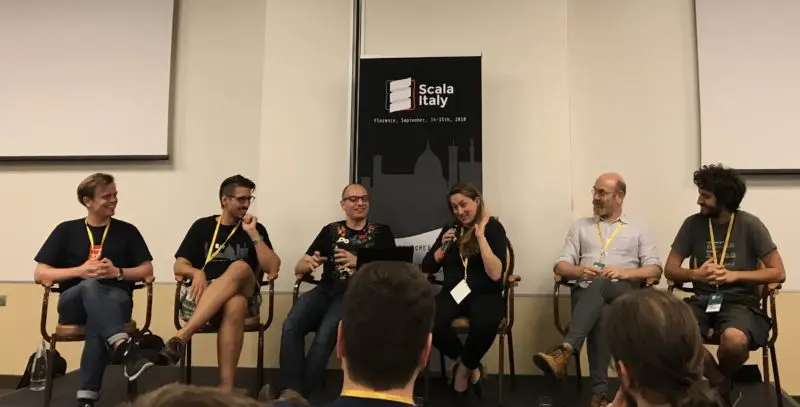
Last weekend, the ScalaItaly conference took place once again in Florence. Over two consecutive days, participants could listen to talks from various areas of software development around the Scala programming language, and various workshops were also offered in parallel. All talks were recorded and can be watched on the internet soon.
The Keynotes
On Friday, the conference began with a keynote by Heather Miller, former director of the Scala Center and now an assistant professor at a US university for distributed systems. Her keynote was about the open-source community and the trend that more and more, even large, companies are jumping on the bandwagon and no longer wanting to pay for software. Open source is great and important, but in her and our view, successful projects should be sufficiently financially supported so that the truck factor doesn’t come into play and the community grows. This factor indicates how many programmers of a project could be hit by a truck before the community would suffer serious damage. Anyone considering an open-source framework can use http://gittrends.io/ for decision-making, for example. Nevertheless, payment contradicts the definition of open source, so the question of how to best support an open-source community monetarily is not easy to answer.
Convergence of stream processing and microservices architecture
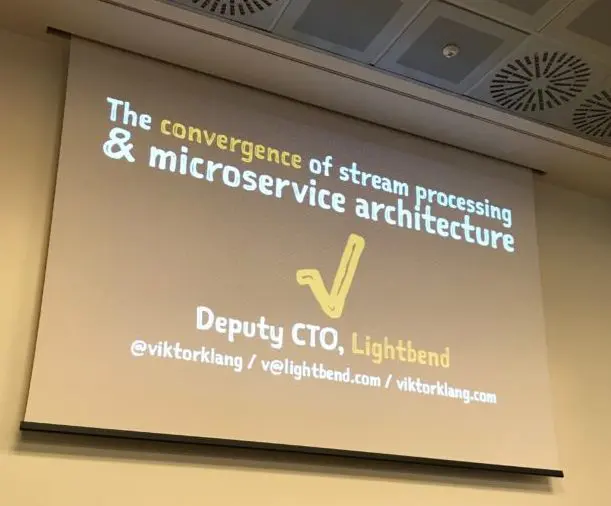
Saturday began with a look into the future of software architecture and the development of modern software systems. According to Viktor Klang, Deputy CTO of Lightbend, the subject areas of data analysis and service processing are moving ever closer together. To illustrate this, he showed the history of both disciplines. For data analysis, he started with offline batches and progressed over the years to modern streaming systems. On the service side, he started with classic client-server architecture and progressed through n-tier systems to modern microservices. In his view, the two sub-areas will converge in the near future, and with reactive systems, both disciplines will be able to process and offer both with just one service. In the end, after all, it’s always about the data. The real-time training of machine learning models based on streaming data will also be possible sooner or later, if you believe Uber’s talk about Data Science with Scala. With akka and Scala, companies are thus very well positioned for the future. Another prediction Viktor made is that services will increasingly move to the edge. The keyword here is edge computing or fog computing. We believe in a similar trend and secured the domain fog-computing.de more than 2 years ago. Systems should be designed more like a pipeline for optimal use, which can be combined with each other via a kind of workflow. Whether data is processed in this pipeline and machine learning models are trained or whether data is delivered via REST to users is then no longer important. The idea of the reactive manifesto is deeply anchored here, and it’s always about data and messages.
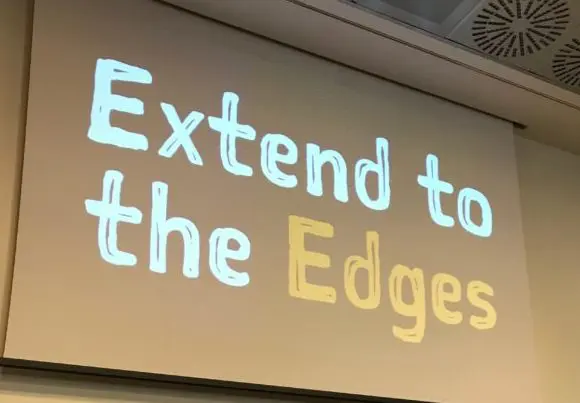
Extend to the edges with edge and fog computing
The Talks and Workshops
The talks and workshops were filled with a lot of knowledge from the Scala ecosystem. There were workshops on sbt, on programming Scala developer tools, on the Typelevel stack, and an introduction to Apache Spark.
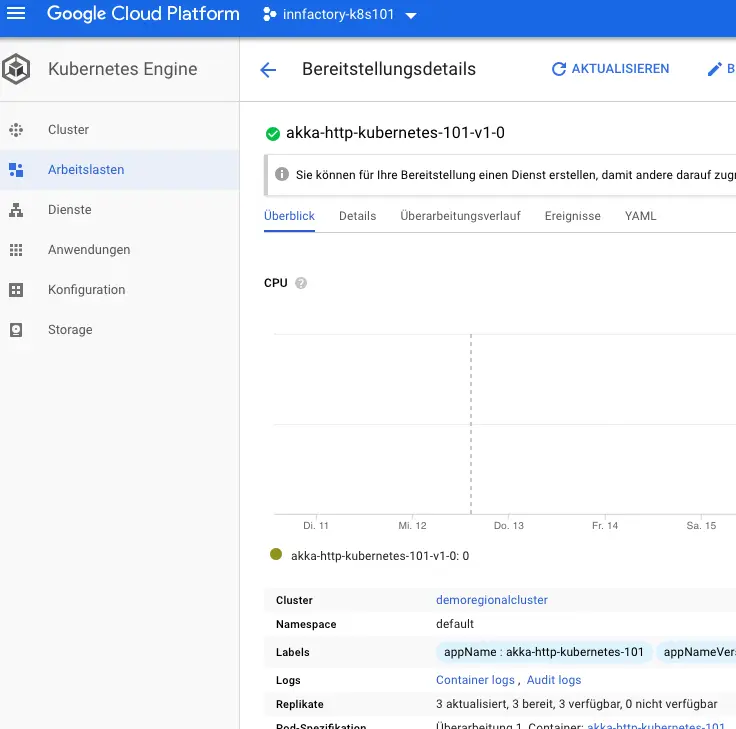
The focus of the talks ranged from very functional talks like kind polymorphism to practical cloud-native talks like Kubernetes with akka cluster. In general, the talks were less for beginners and more for advanced programmers. Particularly exciting was an insight into the life of a data scientist at Uber and how Uber drives platform development with machine learning in a data-driven way. Scala is playing an increasingly larger role in this.
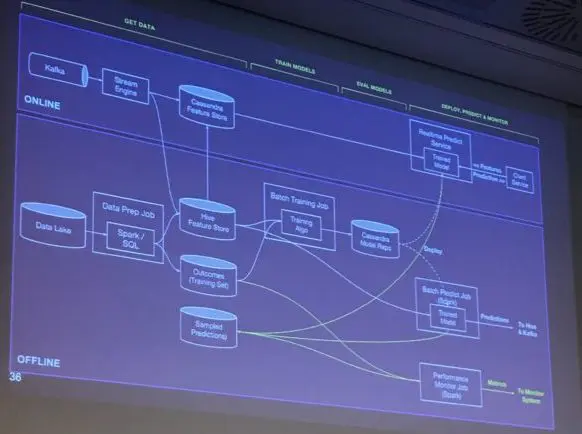
data engineering architecture at uber with spark
Summary
The conference was rounded off with a panel discussion focusing largely on the Scala community and especially Scala 3 (Dotty). We can hardly wait for the first stable release of Scala 3.