Virtual Reality for Machine Learning Visualization in a Smart Factory - Meetup Review
 Maximilian Grassl
2 min read
Maximilian Grassl
2 min read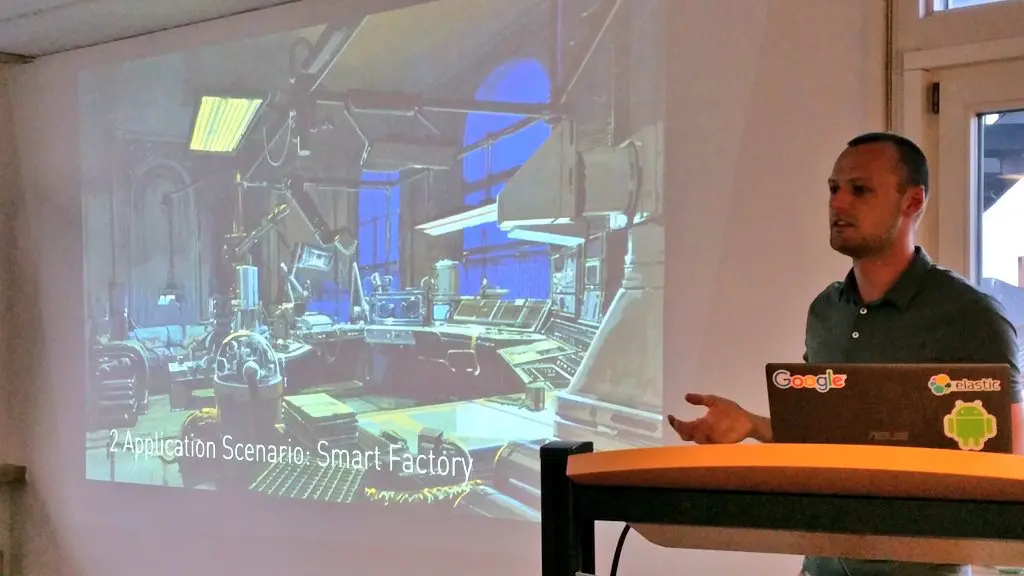
We welcomed nearly 30 listeners to our meetup on Virtual Reality & Augmented Reality (VR & AR for short) last week in the rooms of Stellwerk18. Sebastian Appelt, Innovation Specialist at the Munich company NTT Data, was able to give those present initial insights into the world of virtual reality in his approximately 45-minute presentation.
Fundamentally, the difference between AR and VR lies in the extent of reality alteration created: In the area of Augmented Reality, individual virtual objects are projected into the real environment, whereas Virtual Reality describes the creation of a complete virtual world. The two technologies are implemented using various devices, primarily glasses like the HTC Vive or Microsoft’s Hololens. These devices project images via integrated camera systems that the glasses wearer can see. Depending on the design, individual objects appear for the user, such as flying saucers (AR area), or complete environments in which they are present (VR area). But that’s not all: Through various interaction techniques, the virtual objects can even be controlled and operated. Depending on the device, this interaction can occur through voice, gesture/hand tracking, or eye movements. The use of Virtual or Augmented Reality extends across all areas of daily life: gaming, movies, sales, presentations, driving and flight simulators, car showrooms, … the possibilities are virtually limitless. Of course, such functions are not easily implemented. Developers should therefore familiarize themselves with Unity, Unreal Engine, and C# to be able to develop suitable components.
Besides the areas mentioned where VR and AR are already being used successfully, there is another currently hotly discussed use case: Smart Factory. Here, reality in production environments is combined with virtual components. With the help of various devices, production employees can be equipped, enabling just-in-time data analyses or machine maintenance. Furthermore, thanks to the latest technologies, it is possible to simulate route utilization in factories and thus find the critical path or detect potential route overloads early.
We hope you enjoyed our meetup as much as we did and that you’ll join us again next time! Then probably already in the premises of the new startup center. We will announce the next date and topic in good time. Do you even have a concrete suggestion for a topic that interests you greatly? Let us know, we welcome any suggestion!