Smart Indoor Air Quality Measurements in Classrooms
 Tobias Jonas
4 min read
Tobias Jonas
4 min read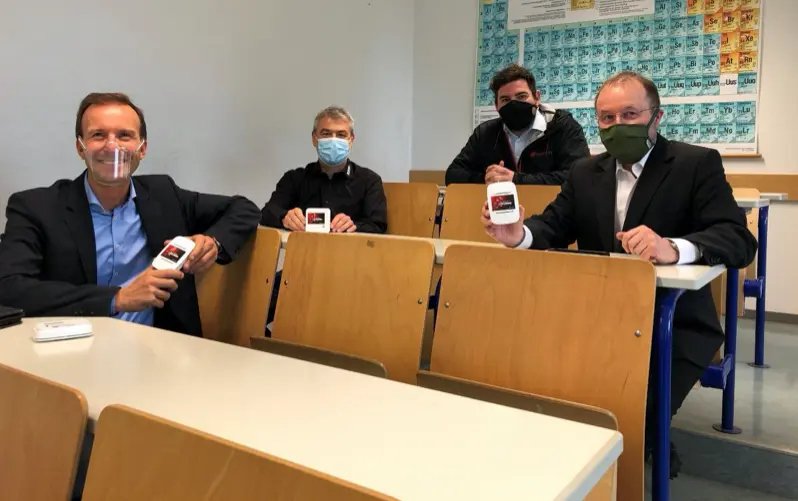
“The sensors have really convinced us. The indoor air quality measurement works reliably and delivers many different values, whether it’s CO2 concentration, temperature, or humidity,” summarizes Dr. Markus Hamberger, Chemistry Department Head at Rosenheim’s Karolinen-Gymnasium, about the multi-week test of indoor air quality sensors networked via komro LoRaWAN.
Through the initiative of Florian Ludwig, a staff member in the school administration of Karolinen-Gymnasium, automated indoor air quality measurements have been running in more than ten classrooms since the beginning of the new school year: “The question of optimal ventilation arises in the classroom every day,” says Ludwig.
A discreet notification on the phone informs teachers as soon as the set CO2 threshold is exceeded in a classroom and it’s time to ventilate the room. And the smart app also gives the all-clear when the CO2 concentration has dropped again. Florian Ludwig: “We deliberately did not and do not want an optical or acoustic signal as soon as a certain value is exceeded. This keeps the lesson undisturbed, no student is distracted, and the teacher themselves decides on the specific timing of burst ventilation in the classroom.”
In Tobias Jonas from the startup software company innFactory, komro found the right partner for developing the customized app. Jonas: “From experience, we know such apps thrive on user-friendliness, on focusing on the essentials: The app automatically shows the current CO2 values from the sensor in the room where the teacher is in the school, or the educator in daycare and kindergarten, supplemented by push notifications when the threshold is exceeded. Calm and without a red flashing light on the wall.”
Throughout the entire LoRaWAN project, the municipal internet provider komro has been cooperating intensively with the Rosenheim University of Applied Sciences since the project’s start. As part of this year’s SE2 project at the university, 10 computer science students in two independent groups worked on visualizing indoor climate measurements in public buildings and schools.
komro Managing Director Gert Vorwalder gladly supports the projects: “The smart sensors in classrooms can become part of modern building management for all public buildings well beyond the pandemic period, thus making a significant contribution to the SmartCity vision.”
The Internet of Things (IoT) refers to the mass networking of sensors and devices over the internet:
IoT networks are mobile data networks for the mass connection of sensors. The technology is optimized for the secure transmission of small amounts of data. The network is not suitable for the transmission of voice and internet services. Only very low transmission powers are required, with excellent electromagnetic environmental compatibility (“green radio technology”) and yet very long range and good building penetration.
About Karolinen-Gymnasium Rosenheim:
Founded in 1890 as a Higher Girls’ School, Karolinen-Gymnasium has developed over time into a modern school for girls and boys and has stood for many years for a broad range of offerings that promote the most diverse talents and interests, as well as for an appreciative school climate.
“KARO” stands for: Kompetenz (Competence) – Atmosphäre (Atmosphere) – Respekt (Respect) – Offenheit (Openness).
About komro:
komro has been the municipal telecommunications company in Rosenheim since 1998 and today offers its over 25,000 private and business customers a variety of modern products in the future markets of internet, telephony, and TV entertainment. Currently, komro offers private customers in the Rosenheim urban area bundle products with telephony and internet access up to 1 Gbit/s via a fiber-coax broadband network covering the entire area. With komro’s modern network, the city of Rosenheim has one of the most future-proof broadband networks with an already high fiber optic share that is constantly being increased. For years, komro has consistently implemented connections in new buildings using future-proof fiber optic technology. komro is increasingly relying on technologies such as FTTB (fiber to the building) and FTTH (fiber to the home).
About innFactory:
innFactory GmbH is a young IT company from Rosenheim that develops, maintains, and operates custom software. The development spectrum ranges from collaborative product development to pure contract development. Founded in 2017 by three students of the Rosenheim University of Applied Sciences, innFactory has already built a large network of local companies and international partners.
Press contact for this press release:
Frank Pauler, Head of Marketing and Sales, Tel. 08031 365-7651, pauler@komro.net