Llama 2: The ChatGPT Competitor from Facebook
 Tobias Jonas
4 min read
Tobias Jonas
4 min read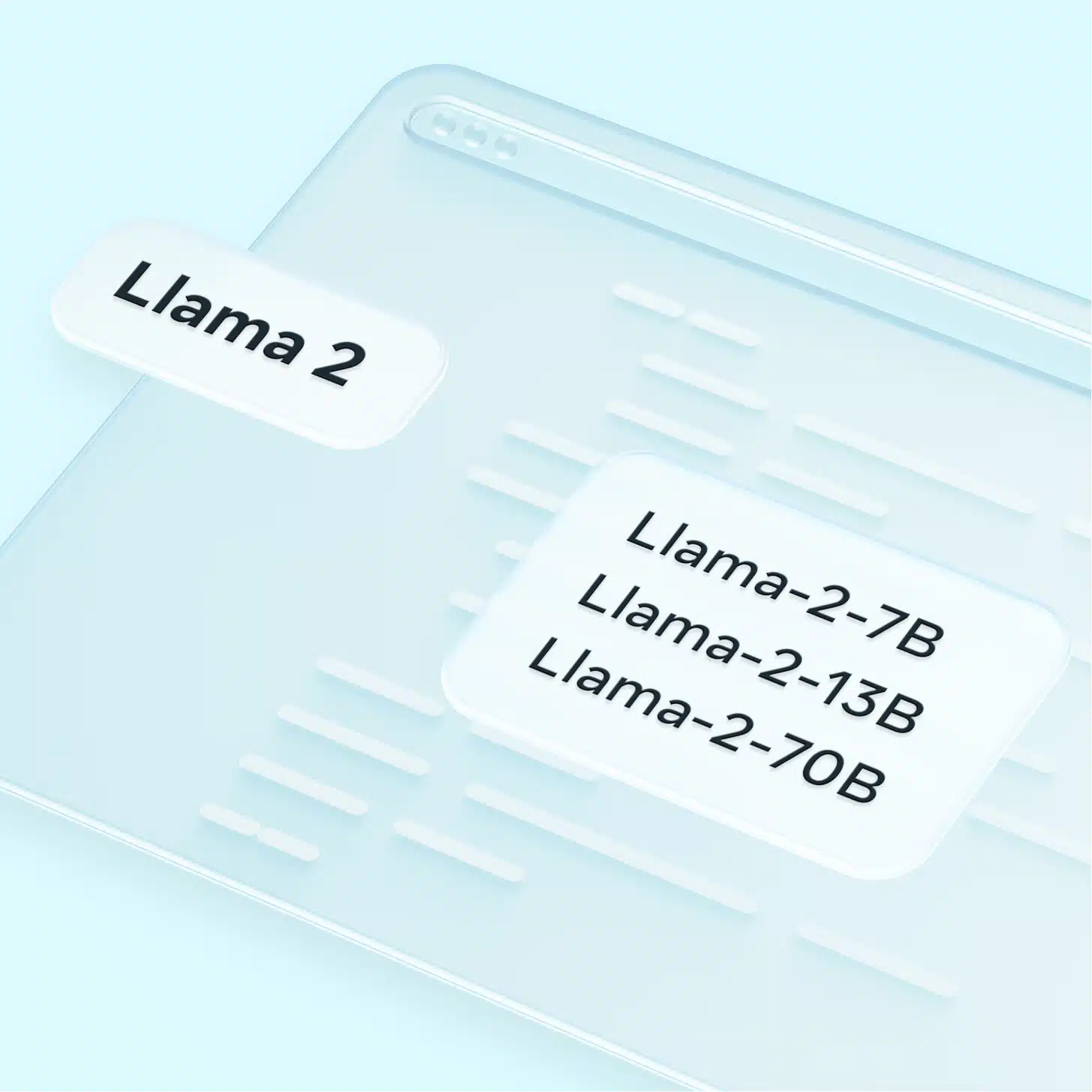
Llama2 – An Overview
Another revolutionary AI model called Llama 2 has been unveiled by Facebook (Meta) and promises to change the AI landscape. Like BARD and GPT3, it is a family of language models that can be integrated into commercial products and offers versatile applications. What exactly can this new AI do and how can innFactory help? Let’s take a closer look.
Llama 2 is a language model trained on an impressive amount of data. At innFactory, we have already had the opportunity to try out Llama 2. We found that Llama 2 outperforms other open-source models on many benchmarks. It demonstrates impressive capabilities and is well-suited for chat applications and similar use cases, even though it may underperform compared to ChatGPT in some areas.
The advantages of Llama 2 lie not only in its performance but also in its flexibility. It is available in various sizes, ranging from 7 billion to 70 billion parameters. Depending on your company’s requirements, you can choose the appropriate model. Above all, the commercial availability of the open-source model is a major advantage over OpenAI’s GPT. Llama can be used free of charge as a foundation for innovation in your company.
How Sustainable is Facebook’s AI Model?
An important aspect in the development of AI models is sustainability and reducing the ecological footprint. Meta, the company behind Llama 2, has consciously addressed the CO2 footprint and energy consumption. They estimated that training the Llama 2 models required a total of 3.3 million GPU hours, which corresponds to approximately 539 tons of CO2 equivalent. These calculations take into account the power consumption of the GPUs but do not include the power requirements of other systems such as data centers or hardware manufacturing. To offset the ecological footprint, Meta announced that 100% of CO2 emissions were compensated through their sustainability program. This step underscores Meta’s commitment to responsible action and environmental protection.
Regarding energy consumption, Llama 2 models were trained on high-performance GPUs that require a significant amount of electricity. However, Meta has also kept energy efficiency and consumption in focus. They have conducted studies to analyze the impact of training on energy consumption and to optimize resource usage. This helps minimize energy consumption and improve model efficiency. Nevertheless, it is important to continue monitoring the energy consumption of AI models and promote sustainable solutions.
Technical Details of the Model
The development of Llama 2 is based on an optimized auto-regressive transformer model. Various techniques and methods were applied to improve performance. These include careful data cleaning, the use of new data mixes, and an increased scope of the pretraining corpus. Additionally, the model’s context length was doubled to enable more comprehensive text context. Another important feature of Llama 2 is the use of “grouped-query attention,” which improves the scalability and performance of larger models.
The pretraining of Llama 2 was performed on Meta’s Research Super Cluster (RSC) using NVIDIA A100 GPUs. During fine-tuning, various techniques were applied, including adaptation to human preferences and the use of reinforcement learning with human feedback (RLHF). Fine-tuning required significant computational and annotation capacities to improve model performance and safety. Meta has also taken measures to increase model safety, including annotation of safety-relevant data and conducting safety tests.
These technical details illustrate the complexity and extensive training invested in the development of Llama 2. By combining advanced techniques and powerful hardware, Meta has created a capable language model suitable for a variety of applications.
Deploying LLama 2 in Your Own Company
If you are interested in deploying Llama 2 and developing your own AI models, innFactory is the right partner for you. Similar to GPT-3.5 or GPT-4 (ChatGPT), innFactory can help you optimally deploy Llama 2 and train your own model for your specific use case. We have expertise in AI development and can assist you in adapting and training Llama 2 models for your specific requirements. With our support, you can develop your own model tailored to your individual needs.
It is important to note that deploying AI models like Llama 2 also brings challenges. There is a risk of misuse or undesired usage. Therefore, it is crucial that deployment is done responsibly. At innFactory, we place great emphasis on security and support you in conducting safety tests and adapting models to minimize undesired effects.
The release of Llama 2 as open source allows companies like innFactory to benefit from this technology and use it for their own products and services. This promotes innovation, transparency, and competition in the AI community.
The future of AI development is exciting, and Llama 2 is an important step in this direction. With innFactory’s support, you can leverage this technology profitably for your company and benefit from the diverse possibilities of AI. Talk to us and discover how Llama 2 can advance your business.
Looking for a Keynote Speaker on Artificial Intelligence?
Our CEO Tobias Jonas is active as a keynote speaker and presenter in the field of artificial intelligence. More information can be found at tobias-jonas.de