CompanyGPT: Enterprise AI Platform with Microsoft Foundry, Foundry Agent Service and Amazon Bedrock AgentCore
 Tobias Jonas
9 min read
Tobias Jonas
9 min read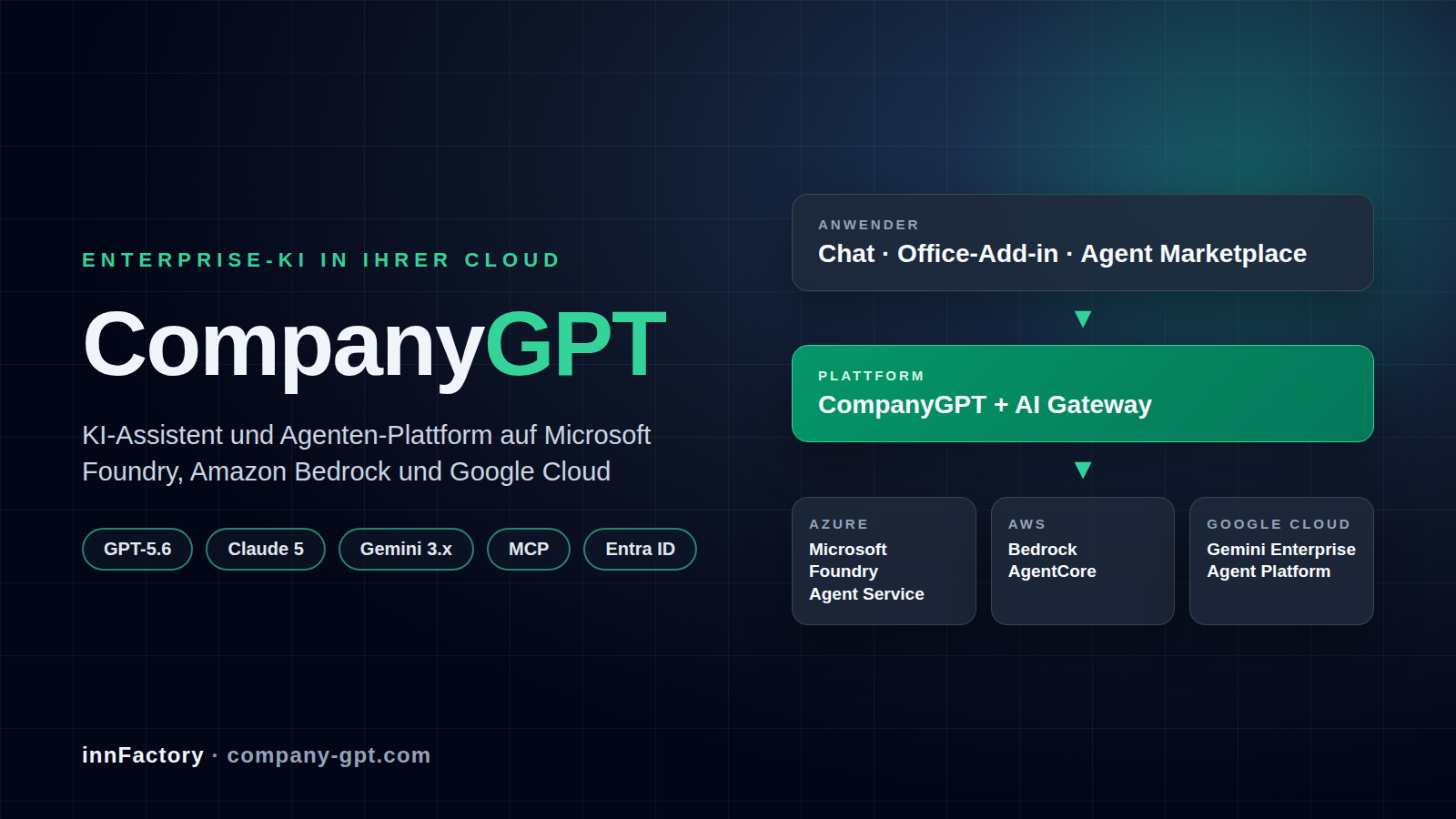
Two years ago the question in most companies was: “How do we get ChatGPT to our employees safely?” Today it is: “How do we get AI agents into our processes without losing control over data, costs and permissions?” CompanyGPT answers both questions with the same architecture: an AI assistant with a familiar chat interface that runs entirely in your own cloud, and underneath it the agent platforms of the hyperscalers, first and foremost Microsoft Foundry with the Foundry Agent Service and Amazon Bedrock with AgentCore. This article shows what CompanyGPT delivers today and why we deliberately base the model and agent layer on these two platforms.
What CompanyGPT is
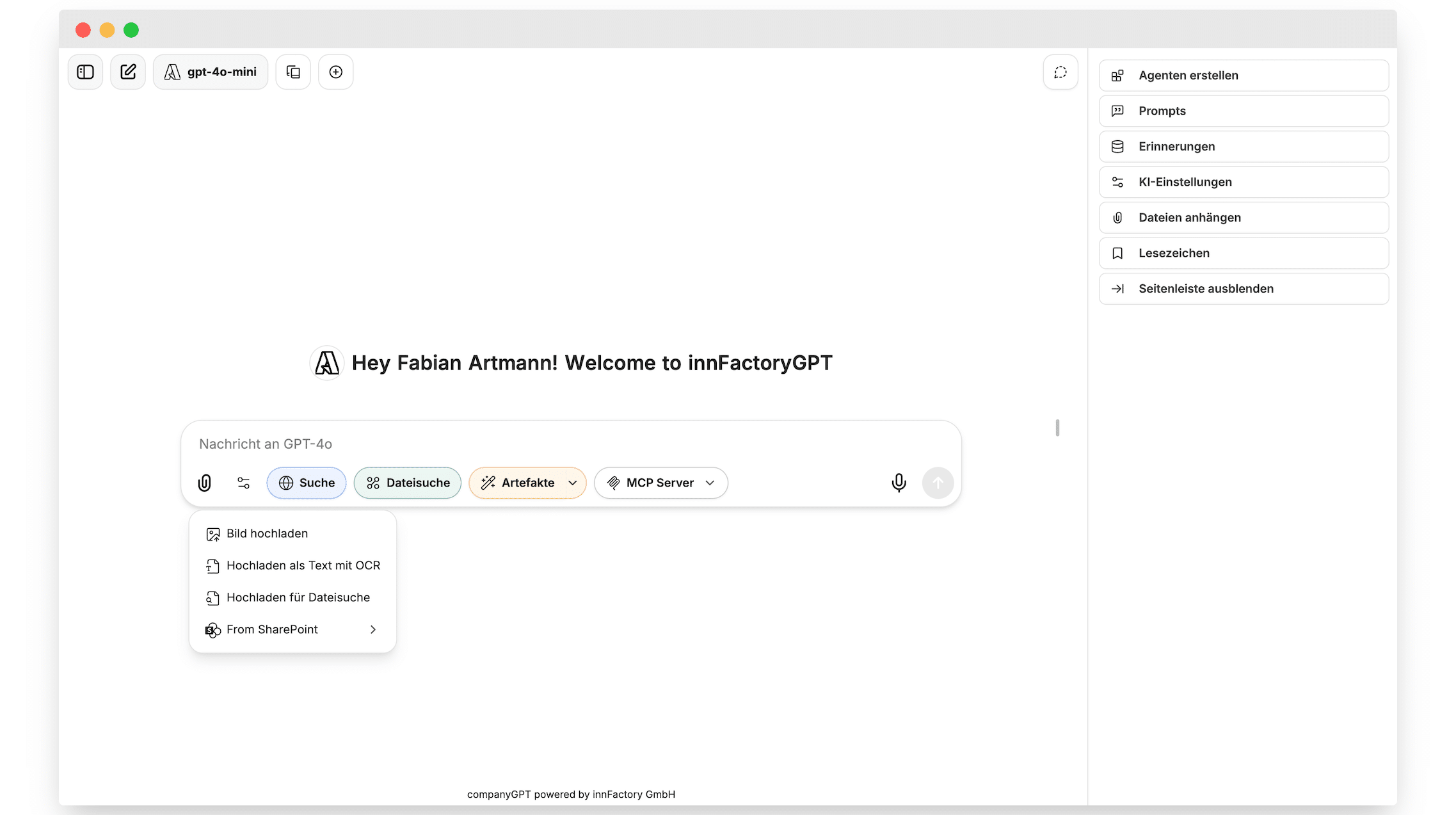
CompanyGPT is the GDPR- and EU-AI-Act-compliant AI assistant that we distribute together with innFactory AI Consulting. The interface follows ChatGPT so that nobody needs training to write the first prompt. The difference is under the hood: CompanyGPT is installed via infrastructure as code in your Azure, AWS, Google Cloud or STACKIT environment. There is no SaaS operator in between, no forwarding of prompts to third parties and no per-seat license. Sign-in runs through Microsoft Entra ID; permissions come from your existing identity management and are synchronized regularly.
The feature set now goes well beyond chat and file upload:
- Multi-model: GPT-5.6 in the Sol, Terra and Luna variants via the EU Data Zone of Microsoft Foundry, Anthropic Claude (Opus 5, Sonnet 5, Haiku 4.5), Google Gemini 3.7 Flash and 3.5 Flash, Perplexity for source-backed web research, Mistral OCR for scanned documents and Nano Banana for image generation. Foundry adds DeepSeek, Mistral and Llama; STACKIT Model Serving adds sovereignly hosted models such as Llama, Gemma and GPT-OSS.
- Agent mode and Agent Marketplace: Business units create their own agents in natural language. A central catalog lists all internal and approved agents with purpose, owner, tags and sensitivity level. Roles and permissions apply at agent level, and every agent activity ends up in the audit log.
- Model Context Protocol: MCP servers connect data sources and tools, from SharePoint to specialist systems to n8n, which itself can act as an MCP server for agents. Our MCP server companyM365 also ships a native Office add-in: CompanyGPT is available as a task pane directly in Word, Excel, PowerPoint and Outlook, without a Copilot license per user.
- Knowledge from your data: The SharePoint integration synchronizes documents, metadata and permissions from cloud and on-premises instances. The AI only sees what the respective user is allowed to see, because the Entra token is passed through to the MCP server.
- Extensions: companyDashboard for user, request and token statistics, companyRAG, companyTRANSLATE, companyTRANSCRIBE and companyFILES for the automatic generation of Word, Excel, PowerPoint and PDF documents.
The package starts at EUR 14,990 as a fixed price for setup, AI policy and employee training. On an ongoing basis you only pay for tokens directly at the model provider; for 10 to 50 users that is typically EUR 500 to 1,500 per month, depending on model choice. The maintenance contract with updates, support and licensing of all innFactory add-ons costs EUR 399 per month if you procure the infrastructure through innFactory GmbH as CSP. All prices exclude VAT.
Why the model layer sits on Microsoft Foundry
Microsoft renamed Azure AI Foundry to Microsoft Foundry effective 1 January 2026. The name is new; the platform has been our standard foundation since the first CompanyGPT deployment, for three reasons.
First, data residency. Via the EU Data Zone, inference and data processing run exclusively in European regions. For professional-secrecy holders there is the added fact that Azure is the only hyperscaler with a standardized § 203 StGB addendum, which we supply as an indirect CSP partner. How this works in detail, including Modified Abuse Monitoring for Azure OpenAI, is described in our article § 203 StGB in the Public Cloud.
Second, model breadth under one contract. The “Foundry Models sold by Azure” are billed through your Azure subscription and run under Azure SLAs and the Microsoft Customer Agreement. You switch between GPT-5.6, DeepSeek, Mistral or Llama without negotiating a new contract. We deliberately treat models from the Marketplace area “from partners and community” separately, because different terms apply there.
Third, billing. As an indirect Microsoft CSP reseller via TD SYNNEX, we invoice your Azure consumption at Microsoft list prices with no markup, no setup fee and no minimum spend. Your IT neither has to top up an Enterprise Agreement nor register a credit card.
Foundry Agent Service: agents with identity, network boundary and toolbox
The more interesting part of Microsoft Foundry is now the Foundry Agent Service, Microsoft’s managed platform for building, deploying and scaling AI agents. It solves exactly the problems on which home-grown agent prototypes fail in enterprises.
Two agent types, one endpoint. Prompt agents are defined purely declaratively: instructions, model, tools, done. Foundry runs them without your own code or containers. Hosted agents bring your own code, written with the Microsoft Agent Framework, LangGraph, the OpenAI Agents SDK, the Anthropic Agent SDK or the GitHub Copilot SDK. Foundry runs them as containers with a managed endpoint, automatic scaling and a dedicated identity. Anyone already running agents elsewhere uses the Responses API directly.
Toolboxes as a managed MCP endpoint. Tools such as web search, file search, code interpreter, custom functions and MCP servers are curated once in a toolbox and then exposed through a single MCP-compatible endpoint with central authentication, governance and versioning. This is where CompanyGPT plugs in: from CompanyGPT’s point of view, a Foundry toolbox is just another MCP server. Agents that your development team builds in the Foundry Agent Service are thus available to your users in CompanyGPT’s Agent Marketplace, with the same roles and audit logs.
Identity and network. Each agent can receive its own Microsoft Entra identity; access to resources and external MCP servers runs through it, optionally via OAuth On-Behalf-Of on behalf of the user. Prompt agents can run inside your virtual network, and hosted agents support bring-your-own VNet with VM-isolated sessions. Conversation state can live in your own resources such as Azure Cosmos DB or Azure AI Search. That is the same private-endpoint pattern we use for databases and storage in the CompanyGPT cloud stack.
Lifecycle. Tracing of every model call and every tool decision, evaluations against regressions, automatic versioning, publishing with a stable endpoint and distribution to Microsoft Teams, Microsoft 365 Copilot or the Entra Agent Registry. The A2A protocol for agent-to-agent communication is available as a preview.
For customers this means: the path from a business-unit agent in CompanyGPT to a productive, monitored enterprise agent does not lead through a second platform, but through the same subscription, the same identity and the same billing.
Amazon Bedrock AgentCore: the second agent platform
Not every customer lives in the Microsoft universe. For AWS-centric companies we deliver CompanyGPT on Amazon Bedrock, and the agent layer there is called Amazon Bedrock AgentCore, generally available since 13 October 2025, including in the Europe (Frankfurt) region.
AgentCore is explicitly framework- and model-agnostic. It works with CrewAI, LangGraph, LlamaIndex, the Google ADK or the OpenAI Agents SDK and with any model inside or outside Bedrock. The building blocks AWS released at GA:
- AgentCore Runtime: serverless runtime with session isolation, supports the A2A protocol
- AgentCore Memory: short- and long-term memory for agents
- AgentCore Gateway: turns APIs and Lambda functions into tools and connects existing MCP servers
- AgentCore Identity: identity and access management for agents
- AgentCore Observability: tracing and metrics across the entire agent run
All services support VPC, AWS PrivateLink, CloudFormation and resource tagging. At the end of 2025 AWS additionally introduced AgentCore Policy and AgentCore Evaluations as previews: natural-language policies that check every tool call at the gateway, and continuous quality assessment against production traffic.
The connection to CompanyGPT follows the same principle as with Foundry: the AgentCore Gateway exposes tools and agents as an MCP endpoint, and CompanyGPT consumes them. For users it is invisible whether an agent runs on Foundry or AgentCore. What matters to you as the operator is that both platforms meet the same requirements for identity, network isolation and traceability.
One gateway across all providers
As soon as several teams, applications and agents use models from Foundry, Bedrock, Google and STACKIT, one layer is missing: who consumed which tokens, which budget applies to which agent, and where are the provider keys? For that we built the innFactory AI Gateway, available since August 2026.
The gateway is written in Rust, OpenAI-compatible and sits as a central proxy in front of all providers: OpenAI, Azure OpenAI, Anthropic Claude, Google Gemini, Mistral, AWS Bedrock, STACKIT, Ollama and your own OpenAI-compatible endpoints. Users are authenticated via Entra ID, budgets cascade across cost centers, teams, users and agents, and provider credentials are stored in Azure Key Vault. The latency overhead is below 50 milliseconds at P95, and a single instance handles more than 700 requests per second. The license starts at EUR 299 per month for up to 50 users, with a 10 percent discount when models are procured through innFactory GmbH’s reselling.
CompanyGPT also works without the gateway. With the gateway, however, the AI platform becomes a governable system: an agent running in the Foundry Agent Service, a workflow in n8n and a development team using Claude Code share the same cost control and the same guardrails.
How a project runs
The effort on the customer side is manageable. If authentication runs through Microsoft Entra ID, your IT’s contribution is typically about one hour, essentially the approval in your tenant. We take care of the rest:
- Fixed-price setup: CompanyGPT is rolled out in your subscription via Terraform and Helm, with private endpoints, Entra SSO and the desired models from Microsoft Foundry or Bedrock.
- AI policy: After a legal intake interview you receive an individual AI policy for the EU AI Act.
- Employee training: The training covers AI literacy under the EU AI Act and, at least as important for cost control, the right model choice. Those who know when Haiku or Luna are enough and when Opus or Sol are needed save up to 80 percent of model costs.
- Go-live and operations: Rollout, maintenance contract, updates through our DevSecOps pipelines, and, if needed, expansion with your own agents in the Foundry Agent Service or on AgentCore.
The AI solution is ready for use within a few weeks. Anyone who needs a fully sovereign variant gets the same platform on STACKIT, as we show in the article CompanyGPT Sovereign.
Conclusion
The discussion around enterprise AI has shifted: it is no longer about whether employees may use a language model, but about how agents with identity, budget and audit trail get into existing processes. Microsoft Foundry with the Foundry Agent Service and Amazon Bedrock with AgentCore provide the platforms for that. CompanyGPT provides the interface, the permission logic and the integration into Microsoft 365; the AI Gateway provides cost control across all providers. Together this makes an AI platform that you own instead of rent.
Want to see CompanyGPT in your environment? Request a demo or talk directly to our cloud team.